📢 Watch the SIMPL Deep Dive again!
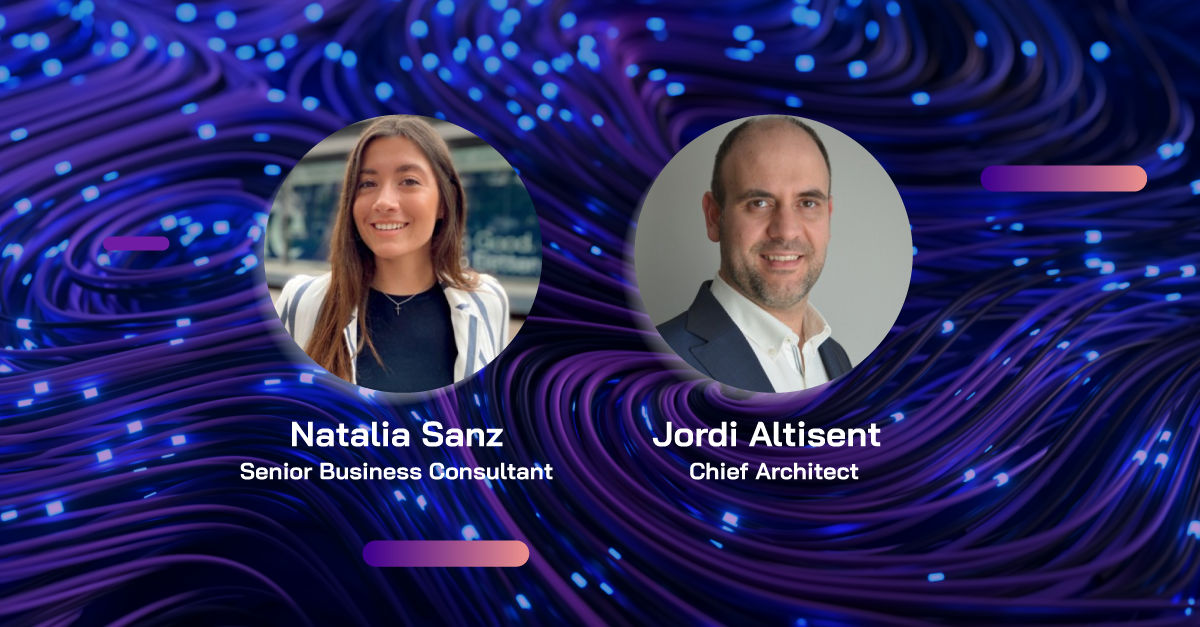
In this session, NTT DATA gives us an insight into the SIMPL programme, its roadmap and the key products that compose it. The speakers of the session were Jordi Altisant (Technical Manager / Chief Architect) and Natalia Sanz y Huguet (Senior Business Consultant), both part of NTT DATA Europe & LATAM.
InfrateX is co-leader of the consortium selected by the European Commission to implement this project. Among others, the products that make up SIMPL were discussed:
Meet the speakers
 |
 |
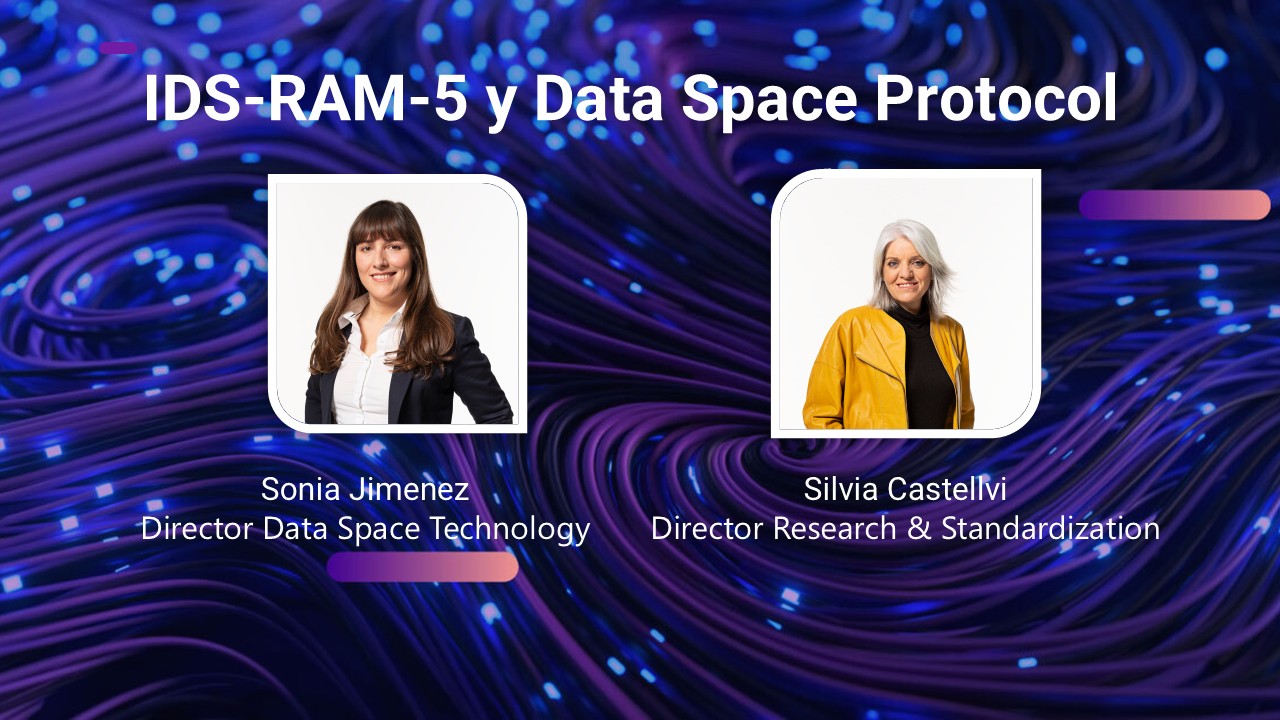
📢 Deep Dive: IDS-RAM-5 and the Data Space Protocol (DSP)
In this session, Sonia Jiménez (Director of Data Space Technology at IDSA) and Silvia Castellvi (Director of Research and Standardisation at IDSA) present the latest developments in IDS-RAM 5, its implications and layers, as well as a collaborative approach proposed by IDSA. We also discuss the Data Space Protocol (DSP), examining its crucial role in the interoperability and security of data exchange, its role as a technical standard, and how it relates to the IDS-RAM architecture.
Some of the key points raised during this session included:
IDS-RAM (IDSA)
Data Space Protocol (DSP)
Meet our speakers
Access the recording and presentation from the session.
 |
 |
BAIDATA takes a look at the new CTN 71/SC 43 Data Spaces committee, established by the Spanish Association for Standardisation (UNE) with the aim of developing standards that ensure data interoperability, governance and sovereignty—all of which are essential for a secure and efficient digital economy.
BAIDATA participates as a member of this committee, and at this webinar we reviewed the working groups in which it participates, as well as providing information to members on how to get involved.
WG1 – Definition and Maturity Model: Defining what a data space is and how to assess its development.
WG2 – Semantic and Technical Interoperability: Developing standards to ensure data is understandable and compatible across systems.
WG3 – Legal and Organisational Interoperability: Overcoming legal and governance barriers to facilitate the secure exchange of data.
Access the recording and presentation from the session.
|
|
On 26 March, a historic milestone came into force: the European Health Data Space (EEDS) Regulation, the first major common sectoral data space in the European Union, as set out in the ambitious European Data Strategy.
This new legal framework marks a turning point in the way electronic health data will be managed, shared and utilised across the EU. Its impact will be transformative for citizens, professionals, researchers, and public and private institutions alike.
In this session on the European Health Data Space Regulation, we had the pleasure of hearing from Itziar Alkorta, Senior Lecturer in Civil Law at the University of the Basque Country (UPV/EHU) and a recognised expert in bioethics and the regulation of new technologies.
What have we covered in this session?
The European Health Data Space (EHDS) is a European Union proposal aimed at promoting secure access to and use of health information. It is based on three objectives: optimising healthcare (primary use), establishing standards for interconnected electronic health record systems, and facilitating the use of data for research, innovation and public policy (secondary use).
Timeline for the exchange of health data:
Access the recording and presentation from the session.
|
|
At BAIDATA, we offer you an initial analysis of the UNE 0087:2025 Specification, the first national technical standard on data spaces. This development represents a fundamental milestone in strengthening the shared data ecosystem in Spain, promoting interoperability, trust and collaboration between sectors.
The UNE 0087:2025 Specification has been developed with broad public-private consensus, under the leadership of the Data Spaces Reference Centre (CRED), chaired by the Secretary of State for Digitalisation and Artificial Intelligence (SEDIA) and the technical secretariat of UNE. This specification establishes an interoperable, inclusive and cross-sector reference framework that facilitates the design and deployment of data spaces in any field.
The standard is presented as a key guide for organisations from different sectors to actively participate in the future of data in Spain, promoting the creation of collaborative and reliable ecosystems.
Access the recording and presentation of the session.
|
|
Deep Dive: Exploring industrial digital twins
In this Deep Dive, led by Jesús Alonso, Director of the Technical Secretariat at BAIDATA, we analyze the concept of the digital twin, a new approach to understanding the digitization of products, services, and processes. A digital twin is a virtual model of a real entity that is connected to it in close to real time. This connection allows data on its condition, operation, and environment to be constantly collected and updated, enabling the analysis of its behavior and the anticipation of decisions.
During the session, it was explained how this technology has the ability to transform isolated data into contextualized information, which allows useful knowledge to be created. For example, a digital twin has the ability to replicate the performance of an industrial machine, the conditions of a street in a city, or even the activity of a cell within a biological context. All of this makes simulation, error prediction, and resource optimization easier.
The importance of international regulations, such as the Asset Administration Shell, which ensure that digital twins are secure and interoperable, was also highlighted. In this context, attendees were informed of the collaboration agreement between IDTA and BAIDATA, an alliance that aims to promote the adoption of this standard in the Iberian Peninsula, foster technical training, and promote the establishment of an ecosystem of digital twins and data spaces in Spain and Portugal.
The development of digital twins represents a decisive step towards convergence between the physical and digital worlds, creating the conditions for a more secure, efficient, and cooperative data economy.
Access the recording and presentation of the session:
 |
 |
The roll-out of data spaces presents a key challenge: how to establish governance models that guarantee data sovereignty and build the trust needed to share information securely, transparently and in compliance with regulations. In environments involving multiple stakeholders, defining clear and common rules becomes essential to ensuring the ecosystem functions properly.
In this context, data spaces emerge as a strategic infrastructure for driving collaboration and value creation, provided they are underpinned by robust and operational governance mechanisms. Consequently, the governance framework (rulebook) is fundamental to structuring the ecosystem, by establishing the set of rules, processes and responsibilities that enable all participants to be aligned.
In this Deep Dive, Francisco Aranda (Senior Legal Consultant – CARSA) discussed the importance of governance in data spaces, the role of the rulebook as a key element in establishing common rules and responsibilities, and the best practices required to ensure the interoperability, regulatory compliance and sustainability of these ecosystems.
Access the recording and presentation from the session.
|
|