

How can data transform urban mobility in Europe?
The innovative deployEMDS project, a key initiative co-funded by the European Union’s Digital Europe programme, represents the next phase of the PrepDSpace4Mobility project and marks a decisive step towards the creation of a European Mobility Data Space (EMDS). It will run for 36 months, with completion scheduled for October 2026, and seeks to enable data exchange between public and private actors to achieve more efficient, sustainable and resilient mobility.
🔹Enable data interoperability between public and private sectors
🔹Create a decentralised, secure, and reusable infrastructure
🔹 Promote more efficient, sustainable, and resilient mobility services.
Cities such as Barcelona, Milan, Stockholm, Lisbon, Budapest and the Flanders region are already implementing real solutions under this framework.
i2CAT and its key role in deployEMDS
i2CAT is leading the development of the technical architecture of the data space for regional pilots, applying its previous experience in projects such as traffic optimisation in Terrassa. It is also coordinating the Barcelona pilot, together with ATM and Nommon, focusing on a data governance system for bus fleets and on-demand transport, with predictive analysis and decision-making support tools.
Expected impact of deployEMDS
Heily Ferrer, Senior Innovation Manager at i2CAT, shared how this project is having a real impact on the mobility data ecosystem in Europe. With practical examples and real-life cases, data is changing the way cities make major decisions about mobility.
Access the recording and presentation from the session.
|
|
📢 Deep Dive: IDS-RAM-5 and the Data Space Protocol (DSP)
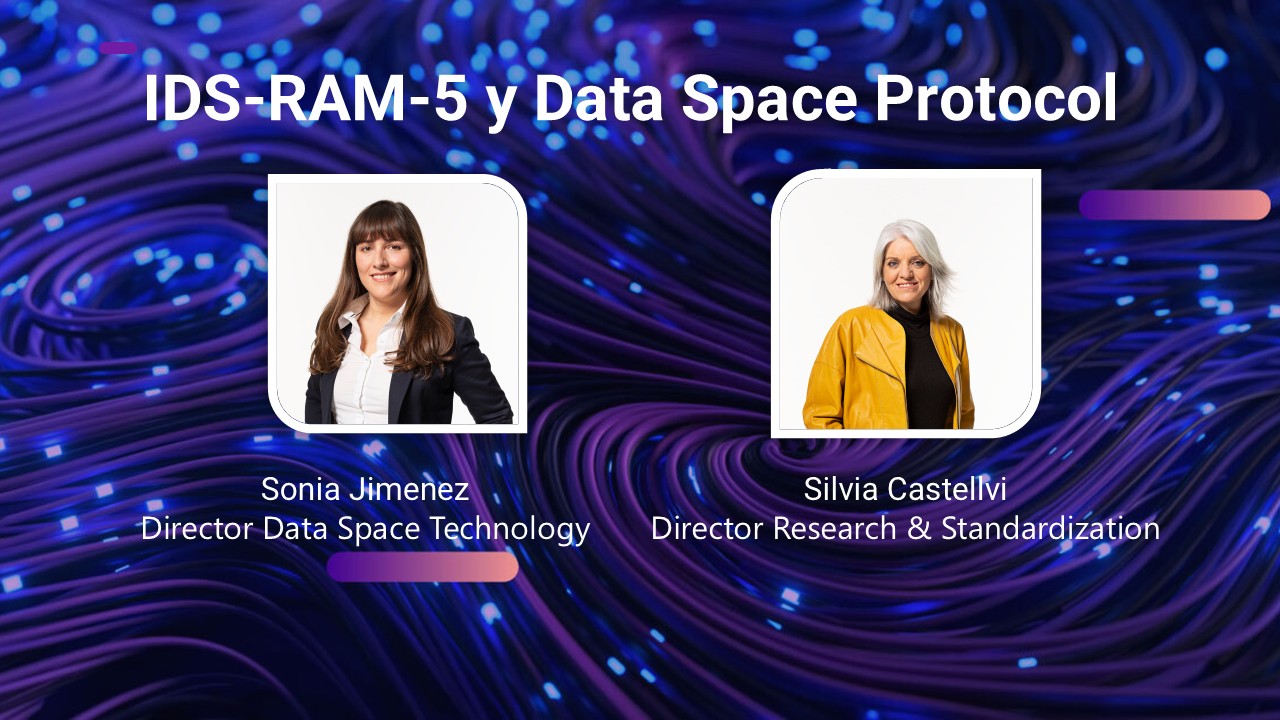
In this session, Sonia Jiménez (Director of Data Space Technology at IDSA) and Silvia Castellvi (Director of Research and Standardisation at IDSA) present the latest developments in IDS-RAM 5, its implications and layers, as well as a collaborative approach proposed by IDSA. We also discuss the Data Space Protocol (DSP), examining its crucial role in the interoperability and security of data exchange, its role as a technical standard, and how it relates to the IDS-RAM architecture.
Some of the key points raised during this session included:
IDS-RAM (IDSA)
Data Space Protocol (DSP)
Meet our speakers
Access the recording and presentation from the session.
 |
 |
On 26 March, a historic milestone came into force: the European Health Data Space (EEDS) Regulation, the first major common sectoral data space in the European Union, as set out in the ambitious European Data Strategy.
This new legal framework marks a turning point in the way electronic health data will be managed, shared and utilised across the EU. Its impact will be transformative for citizens, professionals, researchers, and public and private institutions alike.
In this session on the European Health Data Space Regulation, we had the pleasure of hearing from Itziar Alkorta, Senior Lecturer in Civil Law at the University of the Basque Country (UPV/EHU) and a recognised expert in bioethics and the regulation of new technologies.
What have we covered in this session?
The European Health Data Space (EHDS) is a European Union proposal aimed at promoting secure access to and use of health information. It is based on three objectives: optimising healthcare (primary use), establishing standards for interconnected electronic health record systems, and facilitating the use of data for research, innovation and public policy (secondary use).
Timeline for the exchange of health data:
Access the recording and presentation from the session.
|
|