Come back
Digital Product Passport: legal certainty with eIDAS and blockchain

Este contenido está disponible únicamente para socios BAIDATA.
Regístrate o accede con tu cuenta para verlo.
Come back

For years, a product’s data remained locked away within the factory that manufactured it. That is now coming to an end. European legislation has made it mandatory for manufacturing information to accompany the product, to be understandable to whoever buys, repairs or recycles it, and to withstand any attempt at tampering. It is no longer enough simply to manufacture products well and efficiently: now it is also necessary to demonstrate this through interoperable, accurate data that is shared securely throughout the product’s entire lifecycle.
Basic definition: the Digital Product Passport (DPP) is a structured digital record that brings together a product’s essential information (materials, composition, origin, reparability, environmental footprint and end-of-life) and links it to a unique identifier accessed by scanning a data carrier, such as a QR code, an NFC chip or an RFID tag. When this record is cryptographically sealed and protected against tampering, it becomes verifiable evidence rather than a mere data sheet.
In this article, we explain what eIDAS sealing entails, what blockchain technology adds, how it is applied in a demanding sector such as the automotive industry, and what steps should be taken to ensure readiness.
The Digital Product Passport does not arise in a legal vacuum. It forms part of the European Union’s strategy to regulate the data economy and promote a circular industrial model.
Cross-cutting regulations such as the Data Act, which comes into force on 12 September 2025, and the Data Governance Act lay the foundations for information to flow between businesses, public authorities and consumers under fair and secure conditions, without becoming trapped in closed, single-vendor systems.
At an industrial level, the driving force is Regulation (EU) 2024/1781 on Ecodesign for Sustainable Products (ESPR). The passport will be made mandatory on a product group-by-product group basis, as the Commission adopts the delegated acts. The 2025–2030 work plan prioritises steel, aluminium, textiles, furniture, tyres and mattresses. At the same time, the Batteries Regulation (EU) 2023/1542 brings forward the first mandatory passport: from 18 February 2027, it will be required for electric vehicle batteries, batteries for light-duty vehicles and industrial batteries with a capacity of more than 2 kWh.
The challenge is not technological, but one of data. Accurate information must be gathered from suppliers spread across half the globe, kept available throughout the product’s life cycle (the ESPR even requires a backup copy via a passport service provider) and, at the same time, trade secrets must be protected by determining what the consumer sees and what is visible only to the authorities or recyclers.
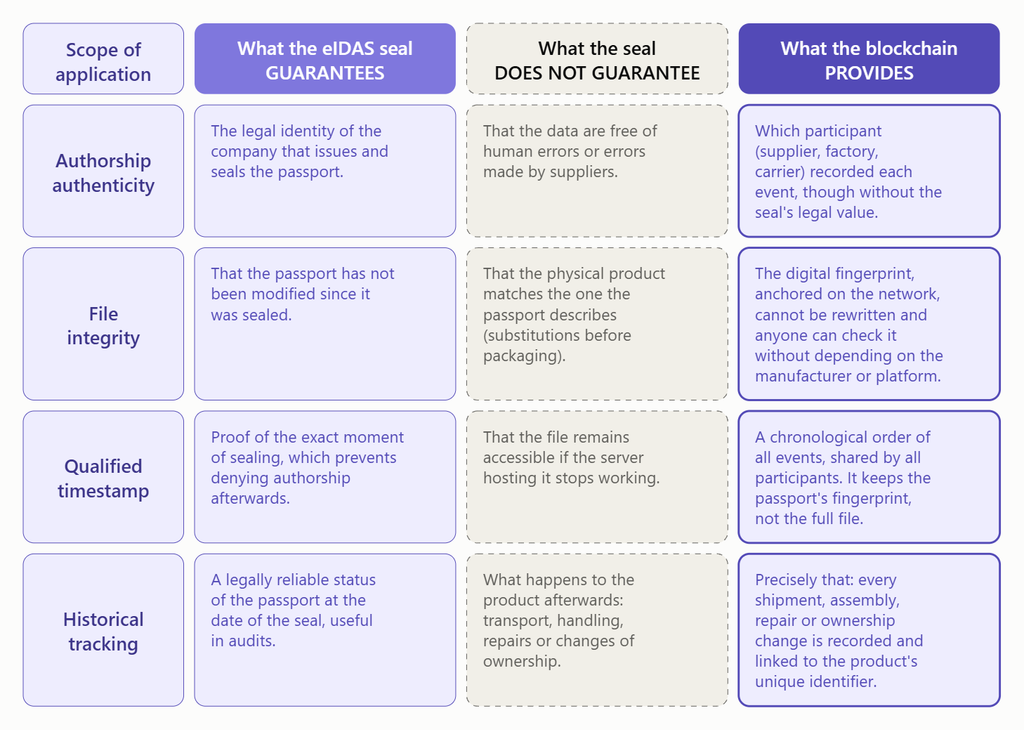
For a passport to have probative value throughout the EU, a qualified electronic seal under the eIDAS Regulation (Regulation (EU) No 910/2014, as amended by Regulation (EU) 2024/1183, known as eIDAS 2) is used. The seal is a tool designed for legal entities: it is issued by the company, not by an employee. The process is simple to explain: the manufacturer generates the passport with the standardised product data; its digital fingerprint (hash) is calculated; that fingerprint is sealed with a qualified certificate issued by a trusted service provider listed on the EU’s trusted lists; and, finally, a qualified time stamp is added to record the exact time. From that moment onwards, the law presumes the integrity of the data and its origin.
The eIDAS seal confers legal validity on a photograph: what the manufacturer declared at a specific point in time. But a product’s life is like a film. Every receipt of raw materials, every quality control check, every change of hands in the supply chain adds new information. This is where blockchain provides an additional layer: a shared, chronologically ordered ledger that is virtually impossible to rewrite, where every event is recorded without any participant being able to delete or alter it retrospectively.
It is important to be precise. Blockchain guarantees that what is recorded cannot be altered, but not that what is recorded is true: if incorrect data is recorded, it will remain on the ledger forever. That is why it works better as a complement to the eIDAS seal than as a substitute. Typically, only the digital fingerprints of documents are recorded on the blockchain, never personal data or confidential information. The ESPR does not mandate the use of blockchain; it is an option for industries requiring particularly robust multi-party traceability.
Below is the actual scope of the eIDAS seal and what blockchain adds to it:
The automotive sector provides a good illustration of the potential of combining eIDAS and blockchain, with one caveat: vehicles are governed by their own sector-specific regulations, and the passport enters the sector via two components with their own timetables: batteries (Batteries Regulation) and tyres (ESPR priority group).
Let us consider a tyre manufacturer. Upon leaving the production line, each unit or batch receives an engraved or printed identifier (QR code, DataMatrix or RFID) that unlocks its passport: composition, origin of the natural rubber, manufacturing plant and test results. The passport is sealed using eIDAS and, if the manufacturer so wishes, subsequent events (dispatch, fitting, retreading, recall) are recorded on a blockchain network.
The benefits are clear:
ESCO TOKEN tackles this challenge as the passport software provider. Its connectors to the manufacturer’s systems (ERP, PIM and online shops) retrieve product data without the need for manual re-entry. The platform manages the eIDAS sealing process with a qualified trust service provider, meaning that it is the manufacturer itself that seals its passport and publishes each passport via a standard GS1 Digital Link accessible via QR or NFC. For industries that request it, it adds a blockchain anchoring module. The manufacturer manages its own data; the technical complexity is handled by the platform.
ESCO stands for European Sustainability Compliance Organiser. The token is the unique digital identity that each product receives when a Passport is sealed.
ESCO TOKEN – European Sustainability Compliance Organiser Token
It is a European software platform for creating, sealing and publishing the Digital Product Passport required by Regulation (EU) 2024/1781 (ESPR). It connects to the manufacturer’s systems (ERP, PIM and online shops) to collect data on each product. It then stamps each passport using eIDAS and publishes it via a standard link accessible via a QR code or NFC. It also allows the passport to be anchored on the blockchain and forms part of the European data ecosystems Gaia-X, BAIDATA and Alastria.
Learn more about the DPP with BAIDATA
This article is part of our series on the Digital Product Passport. If you need support in designing an interoperable and sovereign data architecture that connects your suppliers and your systems, consult the technical guides in the BAIDATA Library or take part in our upcoming Deep Dives webinars.
Not yet part of our ecosystem? Discover the benefits of partnering with BAIDATA to lead the sovereign data economy and stay ahead of the ESPR’s requirements. Request membership information here.