 Come back
DPP Registry: the thread that holds all digital product passports together

Este contenido está disponible únicamente para socios BAIDATA.
Regístrate o accede con tu cuenta para verlo.
Come back

On 20 July 2026, the European Commission launched the Digital Product Passport Registry (DPP Registry), the central infrastructure that will coordinate industrial traceability across the EU. With the entry into force of Implementing Regulation (EU) 2026/1778 on 6 August, the operational framework is now in place. If your company manufactures, markets or develops IT solutions for the European market, you should consider how to adapt your systems.
There is a misconception that the DPP Registry will store all the technical data for every product manufactured or sold in Europe. This is not the case, and understanding this distinction is essential for designing your data architecture.
Established under Article 13 of the Ecodesign Regulation for Sustainable Products (ESPR), the DPP Registry functions exactly like a directory. It indexes unique product identifiers, the links (URLs) to each passport, and the metadata necessary for a market surveillance authority to locate and verify it.
Your product’s operational data is not stored on the European Commission’s servers, but on the infrastructure of your choice: your own servers or those of a DPP service provider. This decentralised model entails a clear responsibility: the register indicates where the information is located, but you are responsible for its safekeeping. In fact, the ESPR regulation requires an independent backup to be in place to ensure that the passport remains accessible throughout its entire lifecycle, even if the issuing company ceases trading.
💡If you would like to see a technical example of how product information is structured before connecting to this European register, we recommend reading our recent article on how the battery passport is created using digital twins and the AAS standard.
To interact with the register, there are two connection methods available:
The European Commission has set up a test environment (sandbox). If you lead a technical or IT team, you should use this environment to simulate and validate the registration of identifiers before the sector-specific delegated acts make the standard mandatory in your industry.
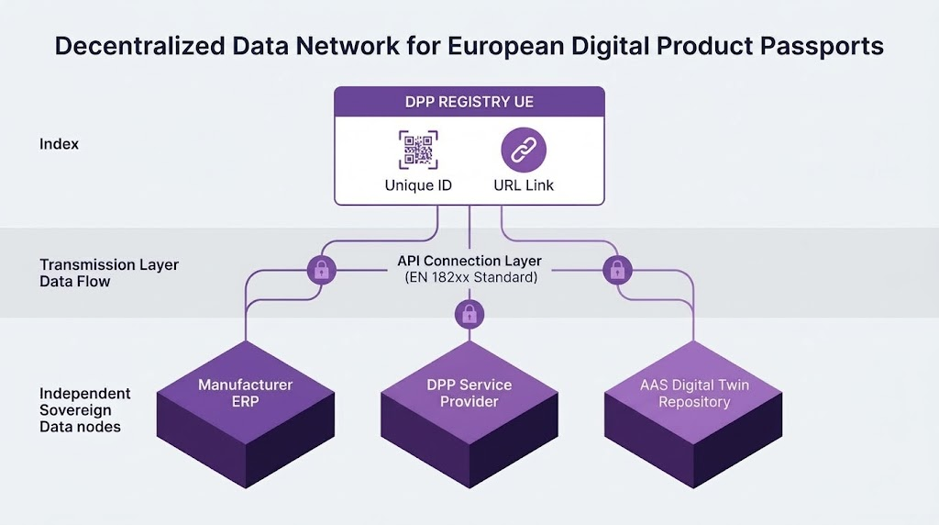
Interoperability between thousands of manufacturers and authorities requires a shared semantic framework. This standard is set by the CEN-CLC/JTC 24 committee through the eight European standards in the EN 182xx series, which cover everything from unique identifiers to APIs, authentication and granular access management.
In July 2026, the first six standards were published in the Official Journal of the EU (OJEU), conferring a presumption of conformity. Following the publication of the last two (EN 18239 and EN 18246) in September, the horizontal technical framework is now complete, pending its phased implementation by sector from 2027 onwards.
Although the DPP Registry infrastructure is already up and running, the legal obligation for your catalogue will depend on the timetable set out in the sector-specific regulations for your product.
To ensure you are fully prepared:
If you need support in designing your data architecture using interoperable and sovereign schemas, BAIDATA can provide you with the necessary resources. You can consult the technical guides in the BAIDATA Library or take part in our upcoming Deep Dives webinars, where we will analyse practical case studies of integration with the DPP Registry.