 Come back
Digital Health in Europe: Toward a more connected and interoperable healthcare system
 Come back

Next March, the general requirements of the European Health Data Space (EHDS) will take effect. This milestone marks the start of the countdown to March 2029, when Phase 1 must be operational: the mandatory exchange of patient summaries and electronic prescriptions (ePrescription/eDispensation) throughout the European Union. Two years later, in March 2031, Phase 2 will be introduced to integrate more complex data such as medical images, lab results, and hospital discharge reports.
Today, each Member State has its own system, infrastructure, and method for managing health data, which in practice hinders this exchange. The question is no longer whether your organization will need to be interoperable, but when and how you will prepare for it.
MyHealth@EU: The first step is now up and running
Even before the full implementation of the EHDS, you can already benefit from an existing framework: MyHealth@EU, the European infrastructure that enables the shared use of certain health data across countries. If your organization works with medical records or medication prescriptions, this affects you directly through two services that require the adoption of common formats and standards:
The EHDS: The framework that changes everything
The real turning point is the European Health Data Space, which came into effect on March 26, 2025. The Regulation has three clear objectives: to give citizens real control over their data, to enable secondary use for research, innovation, or public policy development, and to create a common market for interoperable electronic health record systems.
The key operational point is that the EHDS distinguishes between primary use (direct patient care) and secondary use.
If your work falls within the realm of research or innovation using health data, this secondary use defines the conditions under which you will be able to access information that, until now, has been virtually inaccessible on a European scale.
Why get a head start on the EHDS?
Although the Regulation has been in force since 2025, the required technical implementation is phased:
Adapting your IT infrastructure and adopting new standards takes time. Get a head start today and avoid regulatory roadblocks tomorrow.
Technical Certification: A notice to technology providers
If your company develops healthcare software or Electronic Health Record (EHR) systems, the Regulation is a game-changer. From here on out, systems must comply with the European Electronic Health Record Exchange Format (EEHRxF). This means undergoing strict conformity assessments and CE marking to ensure interoperability, security, and access logging. Designing closed systems or putting up barriers to data export will no longer be a viable business option.
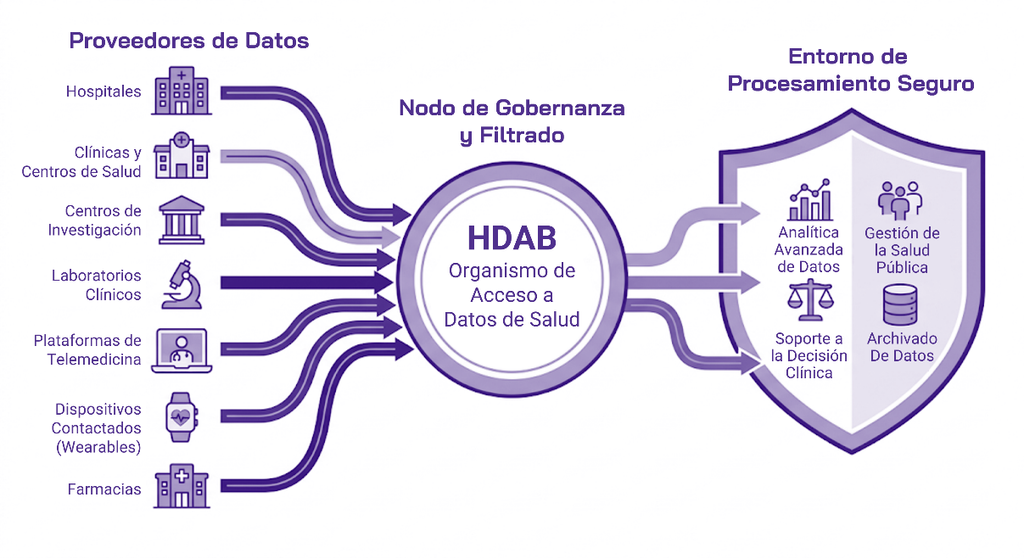
Secondary Use and the New Health Data Access Bodies (HDABs)
The EHDS clearly distinguishes between primary use (direct patient care) and secondary use. If your work falls within the realm of research, innovation, or algorithm training, this secondary use defines the new conditions for access.
To manage this, each country will establish a Health Data Access Body (HDAB). If clinical information is needed for research, you will apply for permission from this body, which will provide access to pseudonymized or anonymized data within secure processing environments. In addition, citizens will have recognized rights of control over their information, including an opt-out mechanism, which will allow them to refuse the secondary use of their health data.
A message for the healthcare sector
The message for hospitals, tech SMEs, insurers, and research centers is clear. European healthcare interoperability is not a long-term promise, but a roadmap with specific deadlines. The sooner you assess how your systems fit into this framework, the sooner you’ll turn a regulatory requirement into a competitive advantage within the European single market for health data.
Explore the EHDS in depth with BAIDATA
To help you take your first technical steps, in the upcoming articles in this series we’ll break down how the two primary use cases set to take effect in 2029 work: the Patient Summary and the ePrescription.
In the meantime, if you’d like to understand the regulatory framework from the ground up, you can access the technical presentation from our Deep Dive: Regulation on the European Health Data Space. In this webinar, presented by Itziar Alkorta [researcher and expert at the University of the Basque Country (UPV/EHU)], we analyse in detail the structure, governance and impact of the regulation following its entry into force.
🔒 Access to this material is limited to member organisations.
[View the Deep Dive presentation here: Deep Dive | European Health Data Space Regulation]