 Come back
ePrescription and eDispensation: A Guide to the European Electronic Prescription

Este contenido está disponible únicamente para socios BAIDATA.
Regístrate o accede con tu cuenta para verlo.
Come back
Being able to collect a medicine in another European country without presenting a paper prescription is not a future project: it is already possible today between several countries connected to the MyHealth@EU network (Spain among them). And from 2029 it will become a reality across the entire European Union.
As we discussed in our introduction to the European Health Data Space (EHDS), the new regulation transforms the cross-border exchange of clinical information. If your organisation develops healthcare software, manages health records or runs pharmacy networks, the question is no longer whether you will have to be interoperable, but how you are going to prepare your systems to operate in this single market for health data.
The EHDS defines primary use as the collection and exchange of clinical information for direct patient care: diagnosis, treatment, prescription, dispensing of medicines and the management of associated administrative or reimbursement services.
In this primary use, the EHDS directly strengthens citizens’ control over their information:
For healthcare professionals, this means faster access to key clinical information on patients coming from other Member States. Within MyHealth@EU, two main electronic services stand out:
The ePrescription is the digital prescription issued by a healthcare professional in the patient’s country of residence, transmitted electronically through the National Digital Health Node. The eDispensation takes place when the pharmacy in the destination country accesses that prescription and dispenses the medicine.
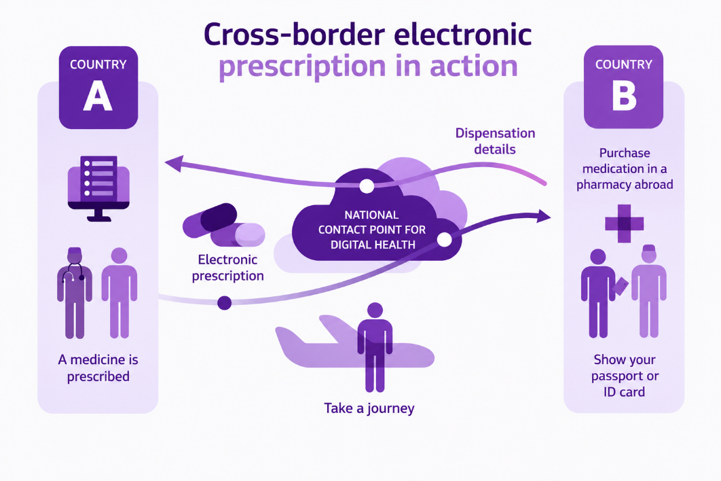
In Spain, the Ministry of Health coordinates the integration of the National Health System (SNS) into this European node, allowing a prescription issued in your autonomous community to be dispensed in the pharmacy network of the participating countries.
Although these services are already operational, extending them across the entire European Union requires overcoming operational divergences between Member States. If your organisation develops or manages prescribing systems, you need to address three technical fronts:
The cross-border electronic prescription confirms that European healthcare interoperability is a technical reality already under way. For hospitals, public health services, pharmacies and software providers, the EHDS sets out a roadmap with specific dates. Assessing how to adapt your systems to the MyHealth@EU specifications will help you avoid regulatory roadblocks and position your technology offering in the European single market for health data.
Go deeper into EHDS interoperability with BAIDATA
This article is part of our technical series on the primary use cases of the EHDS. If you want to analyse the regulatory framework and its architecture requirements from the ground up, you can access the technical presentation of our Deep Dive: European Health Data Space Regulation.
Note: Access to this documentation is exclusive to member organisations.
Not yet part of our ecosystem? Discover the benefits of joining BAIDATA to lead the sovereign data economy and get ahead of the EHDS requirements. Request membership information here.