 Come back
Integrated Mobility Data Platform (EDIM): Advancing towards a national transport data ecosystem
 Come back

On 2 June 2026, the Ministry of Transport and Sustainable Mobility, in coordination with SEDIA, published the Integrated Mobility Data Space Strategy (EDIM) document. Its aim is to define how to organise the sharing of mobility data within a common framework of governance and interoperability. The EDIM was established under Law 9/2025 on Sustainable Mobility and is aligned with the 2030 Strategy for Safe, Sustainable and Connected Mobility.
A high volume of data sharing, but with limited governance
The initial assessment reveals a high volume of data exchange between public sector organisations, but one that relies on mechanisms that are not yet fully developed. If your organisation already shares information, these examples will sound familiar: manual file transfers, partial APIs or the use of email. All of this leads to duplications and inefficiencies, combined with significant technological disparities and the absence of a unified governance framework.
Despite these shortcomings, the sector can rely on a number of key strengths:
The sector in numbers
The Plan to Boost Sectoral Data Spaces is already funding 45 mobility projects, with an investment of over 51 million euros, 28 data spaces and 69 use cases currently underway.
The market is already on the move. Against this context, have you considered what role your organisation will play?
The nature and strategy of the Mobility Data Space
The EDIM is defined as a digital tool within the General Sustainable Mobility System. Its mission is to ensure the availability of mobility information to all public authorities and, under conditions to yet be determined, to managers, professionals, the research community and the general public.
Its design is based on the three pillars set out in the UNE 0087:2025 specification: interoperability, governance and value creation. The proposed governance model is a hybrid one, comprising a Governance Authority, a Standing Committee and the Regional Forum for Sustainable Mobility, which acts as a coordinating body with the autonomous communities and local authorities.
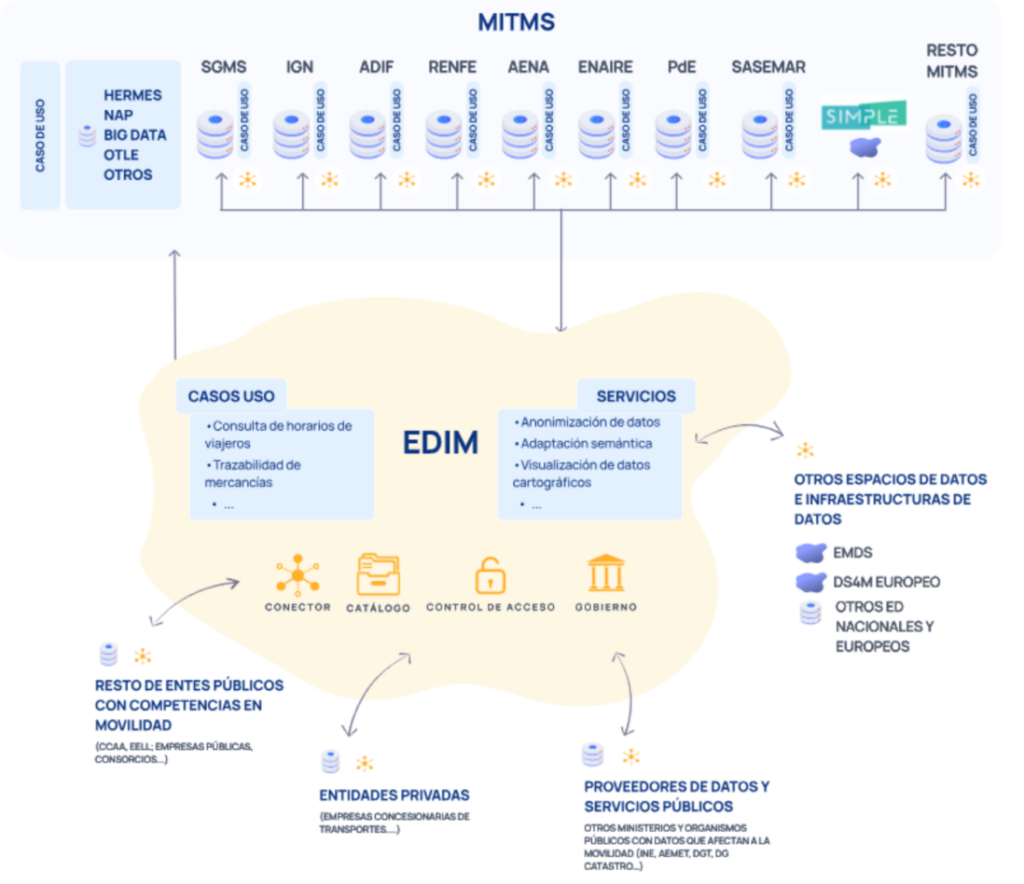
The cornerstone of this entire model is data sovereignty, the very concept we promote at BAIDATA. Each organisation retains its data within its own systems and decides what to share and under what conditions, within a federated model that avoids unnecessary centralisation, as illustrated by its functional diagram:
The 2026–2028 deployment plan
The strategy comprises a roadmap divided into four phases:
The EDIM is designed as a dynamic and scalable infrastructure, intended to converge with the European Mobility Data Space. Here at BAIDATA, we will be closely monitoring this process to keep you informed of the opportunities for innovation and collaboration it creates.
Would you like to find out more about the technical and governance details? The full EDIM Strategy document is available on our BAIDATA Library