 Come back
Urban digital twin: Vitoria-Gasteiz tests its transport system with TWINVERSE

Este contenido está disponible únicamente para socios BAIDATA.
Regístrate o accede con tu cuenta para verlo.
Come back

Cities account for more than 70 per cent of global CO₂ emissions and are home to three-quarters of the EU’s population. This makes them the ideal testing ground for solutions aimed at achieving climate neutrality. If you manage innovation within a local authority or a tech-based SME, you have no probably wondered how to anticipate the impact of a new public policy without taking risks on the ground.
TWINVERSE, a project funded by Horizon Europe as part of the EU’s Smart and Climate-Neutral Cities Mission, addresses this challenge. It was launched in May 2026, will run for three years and brings together 26 partners from seven countries. Its target is to connect the digital twins of five pilot cities (Milan, Cork, Kalamata, Lappeenranta and Vitoria-Gasteiz), enhance them with artificial intelligence and link them via data space tools that allow each city to retain control over its own data.
An urban digital twin is a living, data-driven replica of the city that enables municipal technical teams to simulate a decision before implementing it in the real world. It is neither a map nor a scale mock-up: it is a model that is updated with real-time information (traffic, public transport, cycling, air quality) and answers the question ‘What if…?’.
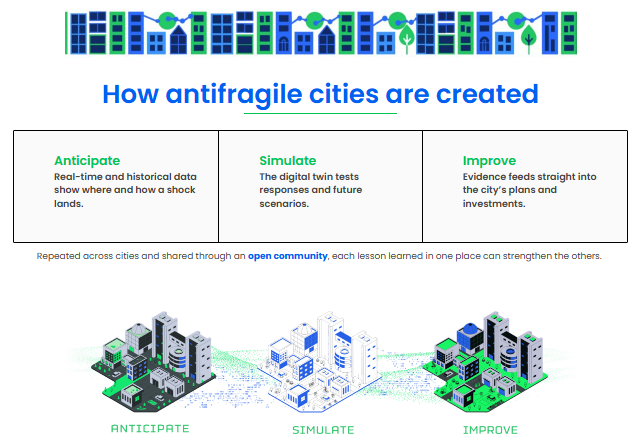
Until now, many decisions regarding mobility were made on the basis of one-off studies or were tested directly on public roads, entailing significant time and financial costs. With a digital twin, scenarios are compared in advance in a virtual environment. TWINVERSE stands out from other initiatives thanks to a double technical approach:
Each city involved in the project covers a different area: energy in buildings, climate risks, access to urban services or urban maintenance. Vitoria-Gasteiz focuses on sustainable multimodal mobility. The aim is for its digital twin to enable:
This holistic approach is essential in a city with a strong tradition of pedestrian-friendly design and a well-established public transport network. ‘What happens to the bus network if the speed of private vehicles is reduced?’ The twin system addresses these concerns before a single sign is installed, establishing itself as a key technical tool.
In the Basque capital, the pilot project is being deployed under the title ‘Multimodal Sustainable Mobility’ and aims to provide technical support for the new Sustainable Mobility and Public Space Plan 2026–2030. The City Council’s Centre for Environmental Studies (CEA) is participating as a municipal partner, providing the data that feeds into the model and proposing test scenarios.
It is this involvement that gives the project its strategic significance. The virtual simulation is not an isolated technological exercise, but a tool to ensure that public policies are based on technical and analytical evidence.
This pilot project draws on a network of initiatives and stakeholders that were already operating data infrastructure in the region:
At the Basque Country Mobility and Logistics Cluster, we promote innovation, cooperation and participation in collaborative projects to strengthen the competitiveness of the Basque mobility and logistics ecosystem. Our network brings together more than 140 organisations and connects companies, operators, public authorities and knowledge providers.
In this context, we are driving forward DS4MOVEUS, the Basque Country’s first mobility and logistics data hub – an initiative aimed at facilitating the secure and interoperable exchange of data amongst the various stakeholders within the ecosystem. At TWINVERSE, we act as an innovation facilitator, connecting the project with mobility and logistics companies across the region and supporting the dissemination of its results.
Our participation in European projects and forums enables us to bring our partner organisations new opportunities for collaboration, knowledge-sharing and involvement in international initiatives. For our partner companies, TWINVERSE also offers an opportunity to gain first-hand insight into how urban digital twins are being developed across Europe and to identify areas where their capabilities and solutions can add value.
We will continue to share updates on the progress of the TWINVERSE pilot and the opportunities it may generate for the Basque Country’s mobility and logistics ecosystem. You can follow the project on its official website and, very soon, in our section dedicated to TWINVERSE.
Do you want to position your organisation at the forefront of the data economy? Developing digital twins and predictive models requires strategic partnerships and access to specialist knowledge. Join the network of public authorities, SMEs and sectoral clusters that are already shaping European standards. Join the BAIDATA ecosystem and gain access to our Demonstration Centres, take part in webinars and form new partnerships.