 Come back
Data Act and Mobility: Key Points on Access to Vehicle Data

Este contenido está disponible únicamente para socios BAIDATA.
Regístrate o accede con tu cuenta para verlo.
Come back

Since 12 September 2025, the user of a connected car (whether the owner or under a renting or leasing contract) has the legal right to access the data their vehicle generates and to decide which company to share it with. In addition, as we discussed in our definitive guide to the Data Act, new vehicles sold in Europe since 12 September 2026 must provide this access by design.
If you run a dealership, an independent workshop, a fleet or an insurance platform, this regulation radically changes your starting point: access to vehicle telemetry and data no longer depends solely on the manufacturer’s will.
A mobility data space is a trusted environment in which transport stakeholders can share data securely and under common rules, without giving up control over the information.
At European level, this infrastructure takes shape as the European Mobility Data Space (EMDS). The European Commission describes it as a technical and governance framework to achieve interoperability in transport.
At national level, this ecosystem lands in strategic projects such as the Integrated Mobility Data Space (EDIM), which drives the transport ecosystem in our country by connecting public and private infrastructures.
In both cases, the approach is purely decentralised: the aim is not to create a giant central database or data lake, but a network to connect ecosystems (public and private) that are isolated today.
However, for these spaces to work, they need raw material. The connected vehicle is one of the largest sources of mobility information, and thanks to the Data Act, we now have the legal layer that was missing for these closed silos to open up in a regulated way and feed the network.
The European Commission has published guidance on applying the Data Act to vehicle data, which clarifies the scope of the regulation on the basis that the information is generated through the use of the vehicle. It affects any product whose main function is not to process data but which, when used, collects information about its operation or environment, as well as connected digital services that exchange data bidirectionally.
The law covers data generated through the use of the vehicle (raw or pre-processed), such as battery charge, charging cycles, AdBlue level, kilometres driven or whether the lights are on.
By contrast, manufacturing and scrapping data are excluded, as is inferred data (that which the manufacturer produces with its own algorithms, such as predictive breakdown reports, range in km or driving style assessments).
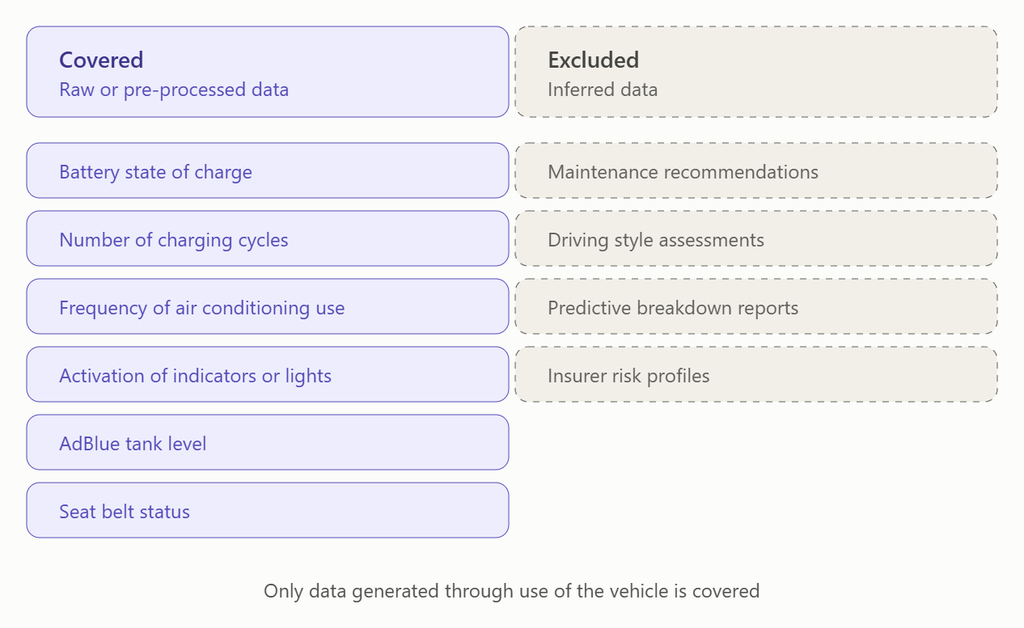
It is also important to stress that the scope is not limited to the information the manufacturer is collecting today, but extends to data that the manufacturer can lawfully obtain without disproportionate effort: even if the brand’s official app does not report the fuel level, it is very likely an easily accessible data point, and they will simply have to enable it if the user demands it.
There is also a relevant exception regarding which third parties can access this data: companies designated as gatekeepers under the Digital Markets Act cannot be third-party recipients (Art. 5.3). This was established to promote the competitiveness of SMEs and prevent abuse of a dominant position.
As a third-party recipient, depending on the design of the car, you will be able to receive the data through two regulated channels:
For your company to be able to receive this data, the process follows a strict circuit:
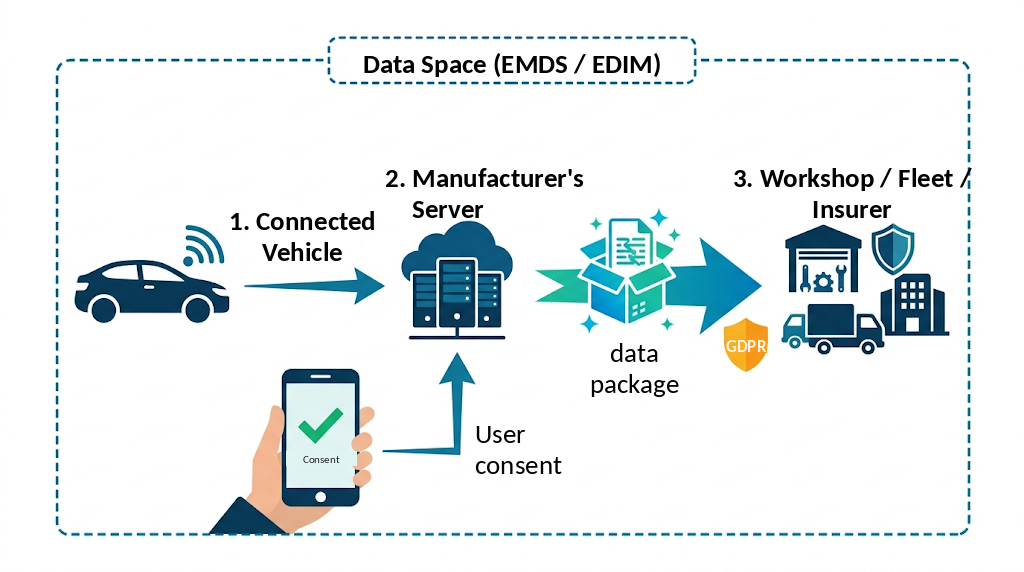
Every new regulation brings undefined areas that the market has to clarify empirically. Moving from a closed model to an interoperable one currently raises three open debates for automotive companies:
BAIDATA takes part in the main forums, projects and working groups that are working to clarify how the regulation applies in practice, and where the most suitable technologies and architectures are being decided.
If you are interested in how the same regulatory logic applies to other sectors, read our post on the Data Act and digital health. And join our Deep Dives and Data in Action sessions to go deeper into the regulation and see how the leading players in each sector are applying it.
Not yet part of our ecosystem? Discover the benefits of joining BAIDATA to lead the sovereign data economy and get ahead of the requirements of the Data Act. Request membership information here.