 Come back
Digital Product Passport (DPP): How to Turn a European Requirement into a Competitive Advantage
Este contenido está disponible únicamente para socios BAIDATA.
Regístrate o accede con tu cuenta para verlo.
Come back
As we recently discussed when detailing the functions of the DPP Registry, the central European registry acts solely as the location index for passports. The real operational challenge for your organization begins afterwards: ensuring that lifecycle data can be shared between suppliers and customers in an interoperable, reliable manner and under strict governance conditions.
Facing the implementation timeline of the Ecodesign for Sustainable Products Regulation (ESPR), your company has two paths: postpone the decision and end up implementing rushed solutions that function as a mere cost center, or seize this requirement to build a comprehensive industrial data strategy. To guide this shift in approach, BAIDATA and Innovalia Association have participated as co-authors in the whitepaper “Building the Trusted Internet of Product Data for Digital Product Passport Ecosystems”, published as part of the European project CIRPASS-2. The document shows how the passport is, in fact, the first large-scale application of a new paradigm: the Internet of Product Data (IoPD).
The Digital Product Passport (DPP) is a structured digital record that compiles information on the composition, origin, environmental impact, durability and end-of-life options of a physical asset. Its initial purpose, set by the European Union, addresses two priority objectives: enabling market surveillance by the authorities and providing traceability to consumers.
The mistake is to treat the passport as a static document silo or a bureaucratic formality. The DPP goes much further, because it aims to be a living document, updated throughout the product’s lifecycle. The European Commission’s Joint Research Centre (JRC) has developed a model for prioritizing technical information, distinguishing between essential, recommended and voluntary data so as not to technically overwhelm companies.
Once those data requirements are set down on paper, the real operational challenge arises: building a B2B infrastructure where sharing that information does not expose your competitive advantages or your intellectual property.
Going beyond regulatory compliance means understanding the DPP as the trigger for deploying the Internet of Product Data (IoPD). Unlike traditional IoT systems, which focus on telemetry from closed devices, or monolithic commercial platforms that store technical datasheets on third-party servers, the IoPD decouples the visual applications from the underlying data-exchange infrastructure.
Under this approach, the product passport is the starting point for unlocking new business returns:
Digitizing technical datasheets or uploading files to isolated repositories does not build a scalable model. The technical paper identifies three bottlenecks that you must resolve in your data infrastructure:
To take advantage of this potential, it is not enough to digitize product information. It is necessary to ensure that data can be shared securely, interpreted correctly and trusted by all the organizations involved. In this regard, three fundamental challenges are identified for moving toward a product data ecosystem at scale:
Sharing information creates value, but it requires safeguarding trade secrets, bills of materials (BOMs) and manufacturing margins. It is essential to apply usage policies that are automatically enforceable at the attribute level, ensuring that you decide who accesses each piece of data, for what specific purpose and for how long, without losing control of the information.
Corporate systems (ERP, MES, PLM) operate with disparate schemas and formats. To avoid custom point-to-point developments between customers and suppliers, data must contain standardized descriptions that any software can interpret unambiguously.
Organizations need to verify the legal identity of their counterparties and the provenance of the data they receive. Without cryptographic evidence of origin, the risk of impersonation, leakage of sensitive data and legal exposure from unsubstantiated environmental claims (greenwashing) increases.
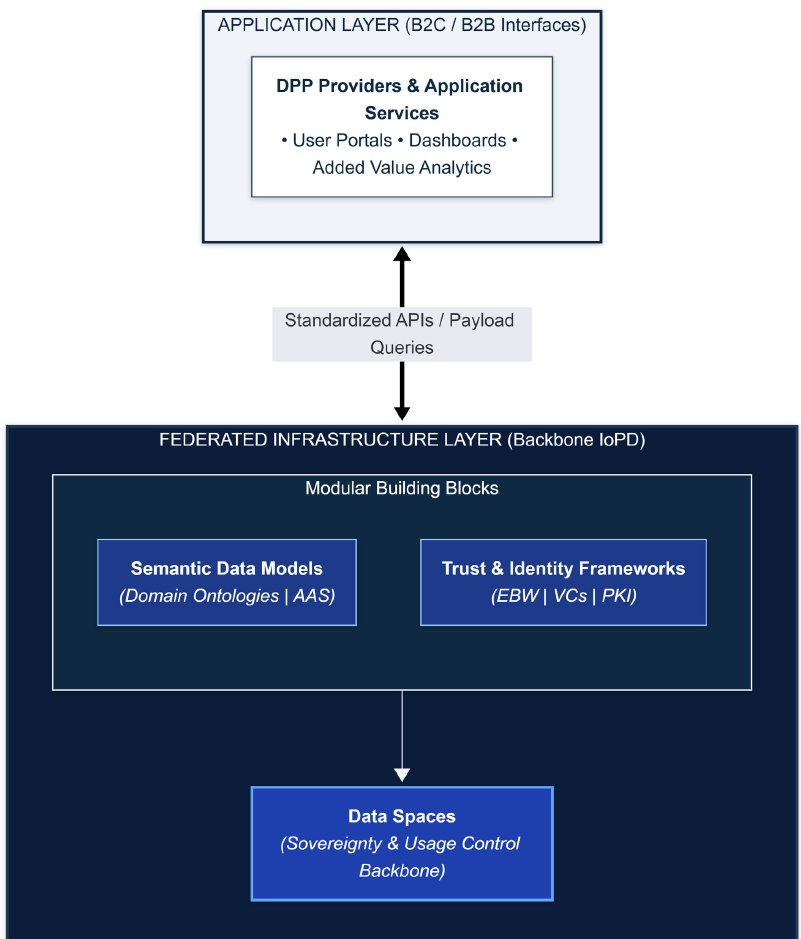
To address these challenges without imposing centralized proprietary platforms, the architectural model proposed by CIRPASS-2 combines three complementary components:
Upcoming BAIDATA Deep Dive Webinar: Practical keys to European Business Wallets with IZENPE
How will the new European identity framework affect your day-to-day operations? To explore this paradigm shift in depth, IZENPE will headline our next Datos en Acción (Data in Action) session. They will explain what business digital wallets are, how they interact with corporate management systems and how they are being applied in practice within the European project WE BUILD, through their use case with IZFE.
Register for free for the webinar here.
This setup ensures that data travels governed by usage contracts, structured in a format interpretable by any agent in the chain and backed by auditable identities.
The whitepaper validates this approach through industrial implementations in various sectors:
The whitepaper “Building the Trusted Internet of Product Data for Digital Product Passport Ecosystems” confirms the contribution of BAIDATA and Innovalia Association to the main European interoperability standards, in close collaboration with initiatives such as the Data Spaces Support Centre (DSSC).
The Digital Product Passport will be mandatory, but the return it generates on your bottom line depends on the technical model you choose. Designing your infrastructure on data spaces ensures that the investment made today serves to lead the circular value chains of the coming years.
Get ahead of the Digital Product Passport with BAIDATA
Download the full whitepaper and consult our technical specifications in the BAIDATA Library.
Secure your spot at the next Datos en Acción on European Business Wallets with IZENPE. Apply to join BAIDATA to participate in our working groups, take part in industrial data space pilots and get ahead of the ESPR timeline.