19/03/2025
📢 Deep Dive: IDS-RAM-5 and the Data Space Protocol (DSP)
In this session, Sonia Jiménez (Director of Data Space Technology at IDSA) and Silvia Castellvi (Director of Research and Standardisation at IDSA) present the latest developments in IDS-RAM 5, its implications and layers, as well as a collaborative approach proposed by IDSA. We also discuss the Data Space Protocol (DSP), examining its crucial role in the interoperability and security of data exchange, its role as a technical standard, and how it relates to the IDS-RAM architecture.
Some of the key points raised during this session included:
IDS-RAM (IDSA)
- It defines the key functions, interactions, components and principles that govern the architecture of an IDS data space. It comprises five layers: business, functional, process, information and system. It also includes three perspectives to consider: security (trust), certification and governance.
- Why a new version?
- To align with the latest developments.
- To include decentralised and federated approaches.
- Various roles within data spaces: to provide architectural guidance for all.
- To present the RAM with a modular rather than a linear approach.
Data Space Protocol (DSP)
- Four layers of interoperability: technical, semantic, organisational and legal.
- The DSP is a set of specifications that facilitates the secure and interoperable exchange of information between entities within a data space. It establishes standardised guidelines on how to access data, how to share it, the rules to be followed and how to exchange data, ensuring compliance with regulations and control over the use of information.
- Advantages of DSP: flexibility, scalability, security and modularity.
Meet our speakers
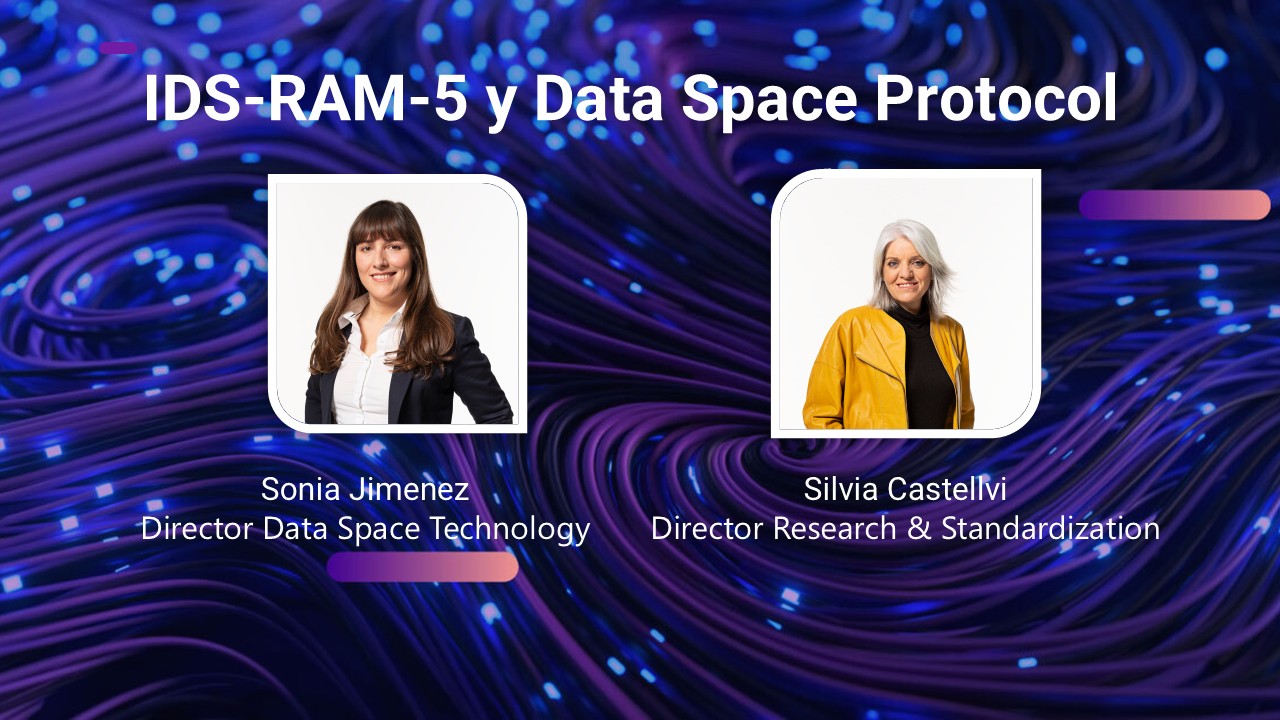
Access the recording and presentation from the session.