 Come back
Patient Summary: the challenge of harmonising the clinical summary of the patient in Europe

Este contenido está disponible únicamente para socios BAIDATA.
Regístrate o accede con tu cuenta para verlo.
Come back

That a healthcare professional in another European country can quickly consult, in a structured way, a patient’s allergies, medication or medical history is already a reality. The Patient Summary is one of the services of MyHealth@EU, the European infrastructure for the cross-border exchange of health data. The European Health Data Space (EHDS) Regulation, in force since March 2025, makes this exchange an obligation for all Member States from March 2029, within the framework of the primary use of health data, that is, its use for the healthcare of citizens.
As we explained in our introduction to the EHDS and in our guide to ePrescription and eDispensation, the new regulation transforms the cross-border exchange of clinical information. For organisations that develop healthcare software or manage electronic health records, the challenge goes beyond exchanging data: it is necessary to ensure that the information is interpreted correctly, keeps its meaning and is useful for healthcare professionals, regardless of the country in which it is consulted.
The Patient Summary is a set of essential clinical information that gives healthcare professionals a quick and structured overview of the most relevant aspects of a patient’s health, especially when they need care in another European country.
In Spain, the Ministry of Health defines the EU Patient Summary (EUPS) as a document containing the most relevant clinical information to facilitate unscheduled healthcare for European citizens outside their country of origin. It is generated from the data available in the electronic health record of the relevant health system.
Its application will be gradual: the obligations relating to the Patient Summary, together with electronic prescription and dispensing, will apply from March 2029, and those for medical imaging, laboratory results and discharge reports from March 2031.
The Regulation itself, in Annex I, sets out what information the Patient Summary must include:
The Patient Summary is part of the cross-border exchange services of MyHealth@EU, together with electronic prescription and electronic dispensing, and is one of the main use cases of this exchange. In simplified terms, the process follows four steps:
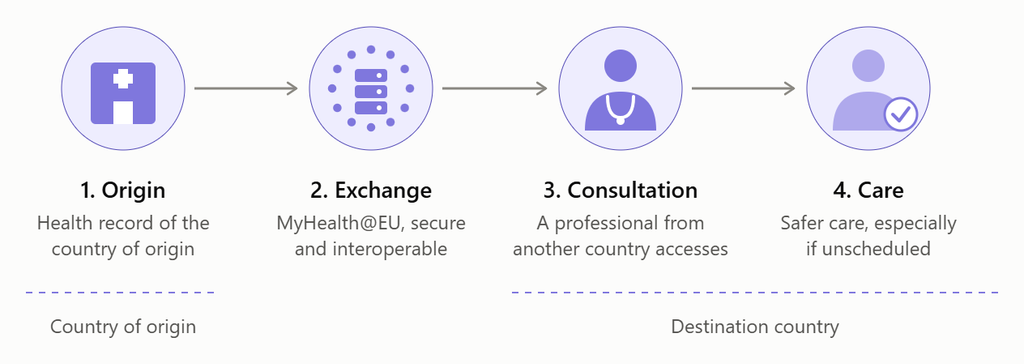
The Patient Summary is not sent automatically, nor is it stored in a centralised European repository. The information remains in the health system of the country of origin and is shared only when a professional who is treating the patient requests it. At that point, the request travels through MyHealth@EU, from the national contact point of the country where care is being provided to that of the country of origin, which makes the summary available to the professional securely. So, if for example a Spanish patient needs care in France, the French doctor can consult their summary at the moment it is needed and read it in their own language. For this exchange to be possible, health systems must overcome several technical and organisational barriers. The diversity of standards, terminologies and national infrastructures poses challenges that go beyond the transmission of data and that are especially relevant in the context of the EHDS.
Sharing this information between countries is not simple: each Member State has its own infrastructures, terminologies and ways of recording clinical data. If your organisation develops or manages health record systems, these are the three fronts that affect you:
This article is part of our technical series on the primary use cases of the EHDS. If you want to analyse the regulatory framework and its architecture requirements from the ground up, you can access the technical presentation of our Deep Dive: European Health Data Space Regulation.
Note: Access to this documentation is exclusive to member organisations.
Not yet part of our ecosystem? Discover the benefits of joining BAIDATA to lead the sovereign data economy and get ahead of the requirements of the EHDS. Request membership information here.